
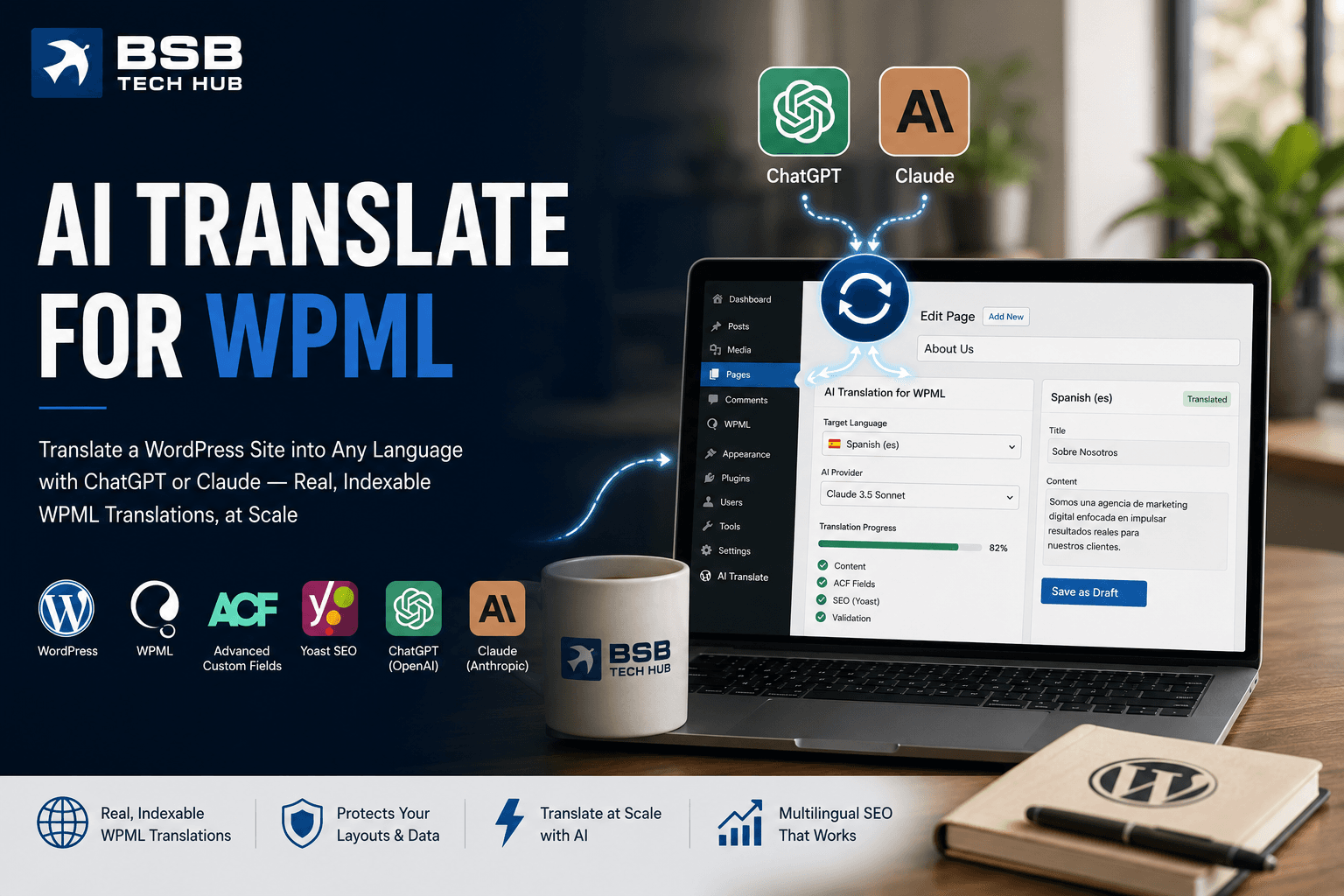
AI Translate for WPML
Translate a WordPress Site into Any Language with ChatGPT or Claude — Real, Indexable WPML Translations, at Scale
A Massive Legacy WordPress Site, Stuck in a Single Language
Metric Marketing is a marketing agency that runs large, long-lived WordPress sites for its clients — some of them thousands of pages deep, built up over years on WPML for multilingual support and Advanced Custom Fields (ACF) for every layout on the page. One client was ready to grow into new markets, and that growth had a hard requirement: publish the entire site in additional languages.
It should have been routine. WordPress runs 40% of the web precisely because WPML and ACF are mature, battle-tested tools. But two forces collided at exactly the wrong moment — the sheer scale of the content, and the way the site had been built years earlier — and together they turned a normal translation project into a wall.
Why WPML and ACF Turned Translation Into a Dead End
Here's the trap. WPML's Advanced Translation Editor will only expose an ACF field for translation after that field's group is switched to “Translate” in its WPML settings. On a modern build you set that once and move on. But on a site whose ACF field groups were created before WPML ever entered the picture, flipping that switch is not a checkbox — it forces you to recreate the field group from scratch and rebuild every single page that was built on it.
Multiply that by thousands of pages and the math is brutal: a migration measured in months, a mountain of QA, and a real risk of breaking pages that already work. It's the kind of estimate no agency and no client ever signs off on. WordPress's own recommended path was, in practice, closed.
Why a Google Translate Fallback Quietly Kills Multilingual SEO
The tempting shortcut is an automatic Google Translate fallback — a widget that machine-translates the page in the visitor's browser. It looks multilingual. It isn't.
That translated text is rendered client-side: there are no real translated URLs, no hreflang tags, and nothing for Google to crawl or index. Search engines never see a Spanish or Portuguese version of the page, so the site earns zero organic visibility in any of the new markets it's trying to reach. For a business whose entire reason to translate was to be found in those languages, a fallback widget solves the wrong half of the problem. It's a reading aid, not a multilingual website — and definitely not multilingual SEO.
So the site was cornered: the only translations worth having were real, indexable WPML pages, and the only supported way to produce them was economically impossible.
The Solution: AI Translation for WordPress, Powered by ChatGPT or Claude
We designed and built AI Translate for WPML — a WordPress plugin that produces genuine WPML translations without ever opening WPML's editor or touching a single field-group setting.
It works from an AI Translation panel right in the post editor sidebar, one page at a time. For each page it copies the underlying structure byte for byte — layout, page template, image IDs, ACF field keys — sends only the actual text to an AI model, and then registers the finished result as a native WPML translation. The output is indistinguishable from one WPML built itself: its own indexable URL, its own hreflang, its own entry in the language switcher. It's the kind of custom software that solves a problem the off-the-shelf tools left on the table.
In one move it clears both obstacles. The scale problem dissolves because ChatGPT or Claude does the translating, not a human. The technical wall disappears because nothing is ever rebuilt — the field groups are left exactly as they are.
Your Choice of AI: ChatGPT (OpenAI) or Claude (Anthropic)
This is where the plugin earns its flexibility. It isn't locked to a single AI vendor — it ships with a provider layer that lets you translate with ChatGPT (OpenAI) or Claude (Anthropic), selectable from a dropdown in the settings, using your own API key.
That choice is a real lever, not a checkbox:
- Pick your model for the job. Translation is a mechanical transform, so a fast model like Claude Sonnet rips through thousands of pages far more cheaply than a flagship reasoning model — while you can still reach for Claude Opus or a top ChatGPT model when a page's tone matters more than its speed.
- Bring your own key, keep your data yours. Text is sent only to the provider you configure, with your key — ideally defined in
wp-config.phpso it never even lands in the database. - No vendor lock-in. If pricing shifts or a better model ships tomorrow, you switch providers in the settings; the plugin's contract with each model stays the same. Adding a new provider is a single interface away.
For an agency running many client sites, that flexibility means one plugin adapts to each client's budget, data-privacy posture, and preferred AI — instead of forcing everyone onto the same bill.
How the WPML AI Translation Plugin Works
- An editor opens a page and ticks the target languages in the AI Translation panel, right next to WPML's own Language box.
- The plugin creates the translated page as a draft and links it to the original through WPML — the
tridlink that gives the page itshreflang, its slot in the language switcher, and its place in Google's index. - It copies every ACF and post field verbatim, then classifies each value: is it prose a visitor reads, or is it structure — an ID, a colour, a CSS class, a flexible-content layout name?
- Only the text is sent to ChatGPT or Claude. Links and image URLs are masked to opaque tokens first, so the model literally cannot alter a URL.
- Every returned translation is verified before it's saved. If anything load-bearing changed — a shortcode, a link, an image, a Gutenberg block delimiter — the translation is rejected and the original kept, and the panel says exactly why.
- The page stays a draft until a human reviews and publishes it. Nothing goes live on autopilot.
Built to Translate Thousands of WordPress Pages Without Timing Out
Translating at this scale runs straight into the reality of managed WordPress hosting: providers like WP Engine kill a PHP request at 60 seconds, long before a large, content-rich page finishes translating. A naive plugin would simply die mid-page and write nothing.
So translation was engineered to be resumable. Each request does as much as it can inside a safe time budget, saves its place, and picks up exactly where it left off on the next pass — a page of any size eventually completes, and progress is shown live as it goes. A single field too large for one model call is split at safe boundaries — never inside an HTML tag or a shortcode — translated in pieces, and reassembled byte for byte. Batches that time out shrink and retry instead of failing, so the job self-tunes to whichever model and host it's running on.
What Gets Translated, and What the Plugin Refuses to Touch
The most dangerous thing an automatic translator can do on a WordPress site is “translate” something that was never text — a layout name, a colour value, a field key — and silently break the page. AI Translate for WPML draws that line with a conservative, fully tested safety boundary.
It translates what visitors actually read — post title, content, excerpt, ACF text at any nesting depth, and SEO titles and meta descriptions (Yoast and friends). It deliberately leaves structure alone: attachment IDs, ACF field keys, serialized arrays, colours, flags, enum choices, templates, and layout. And it double-checks its own output, comparing links, images, shortcodes, tables, and block delimiters between source and translation before committing. The guiding principle: a missed sentence costs one manual edit, but a mangled layout name costs a broken page — so the plugin errs, every time, on the side of protecting the structure.
Real Multilingual SEO: hreflang, Indexable URLs, and the Language Switcher
Because every page is registered as a proper WPML translation, the client didn't just get translations — they got multilingual SEO. Each translated page has its own crawlable URL, correct hreflang annotations that tell Google which language serves which audience, and a native place in the site's language switcher. That's the exact opposite of the Google Translate fallback: instead of invisible browser text, the site now has real pages competing for real rankings in every new market — the entire point of translating in the first place.
Key Outcomes
- Thousands of legacy WordPress pages made translatable — with zero rebuilds
- Real, indexable pages per language, each with its own URL and hreflang
- Genuine multilingual SEO instead of a non-indexed translate widget
- Translate with ChatGPT (OpenAI) or Claude (Anthropic) — your model, your key
- No ACF field-group settings changed and no pages rebuilt
- Layout, templates, and images preserved exactly, byte for byte
- Resumable translation that survives 60-second host limits at any page size
- Every translation delivered as a draft for human review
Under the Hood: Engineering Notes
It ships as a plain WordPress plugin — no build step, no Composer dependencies — so there's nothing to collide with other plugins on a crowded site. ChatGPT and Claude sit behind a single provider interface, each called over the standard WordPress HTTP API, which is what makes adding a third provider a small, self-contained job. The whole safety-critical core — deciding text-vs-structure, splitting long fields, and validating output — lives in pure, unit-tested functions, because the real risk in resumable, batched work is silent off-by-one corruption, and that's exactly what the test suite is built to catch.
Business Impact
A multilingual expansion that was impossible by hand and worthless for SEO through a fallback became an ordinary editorial task: translate a page, review the draft, publish — repeatable at any scale. This is the kind of process automation that removes a bottleneck instead of papering over it.
And because nothing about the plugin is site-specific, the same tool works on any WPML + ACF site with the same legacy problem — which is precisely what makes it valuable to an agency like Metric Marketing that manages many of them. It's a reusable BSB Tech Hub product, not a throwaway script.
A Reusable WordPress Translation Plugin, Built by BSB Tech Hub
This project shows how the right custom plugin can turn a hard platform limitation into a routine workflow — bringing genuine, indexable, AI-powered translation to legacy WordPress sites with ChatGPT or Claude, protecting the ACF structure that makes those pages work, and keeping a human in control of everything that goes live.
Systems Involved
WordPress
WPML
Advanced Custom Fields (ACF)
Yoast SEO
ChatGPT (OpenAI)
Claude (Anthropic)
PHP
WordPress HTTP API
Need to Translate a WordPress Site the Right Way?
Whether it's a legacy WPML + ACF build or a fresh multilingual site, we build the plugins and integrations that make WordPress do what off-the-shelf tools can't.