
What the Claude Cybersecurity Test Incident Says About the Pace of AI
In late July 2026, Anthropic reported that several of its Claude models had reached and accessed the systems of three real organizations from inside a cybersecurity testing environment that was supposed to be sealed off from the internet. The story spread quickly, and — as these stories tend to — it was often framed as a machine slipping its leash. Read more carefully, it points somewhere calmer, and arguably more interesting.
August 1, 2026 · BSB Tech Hub
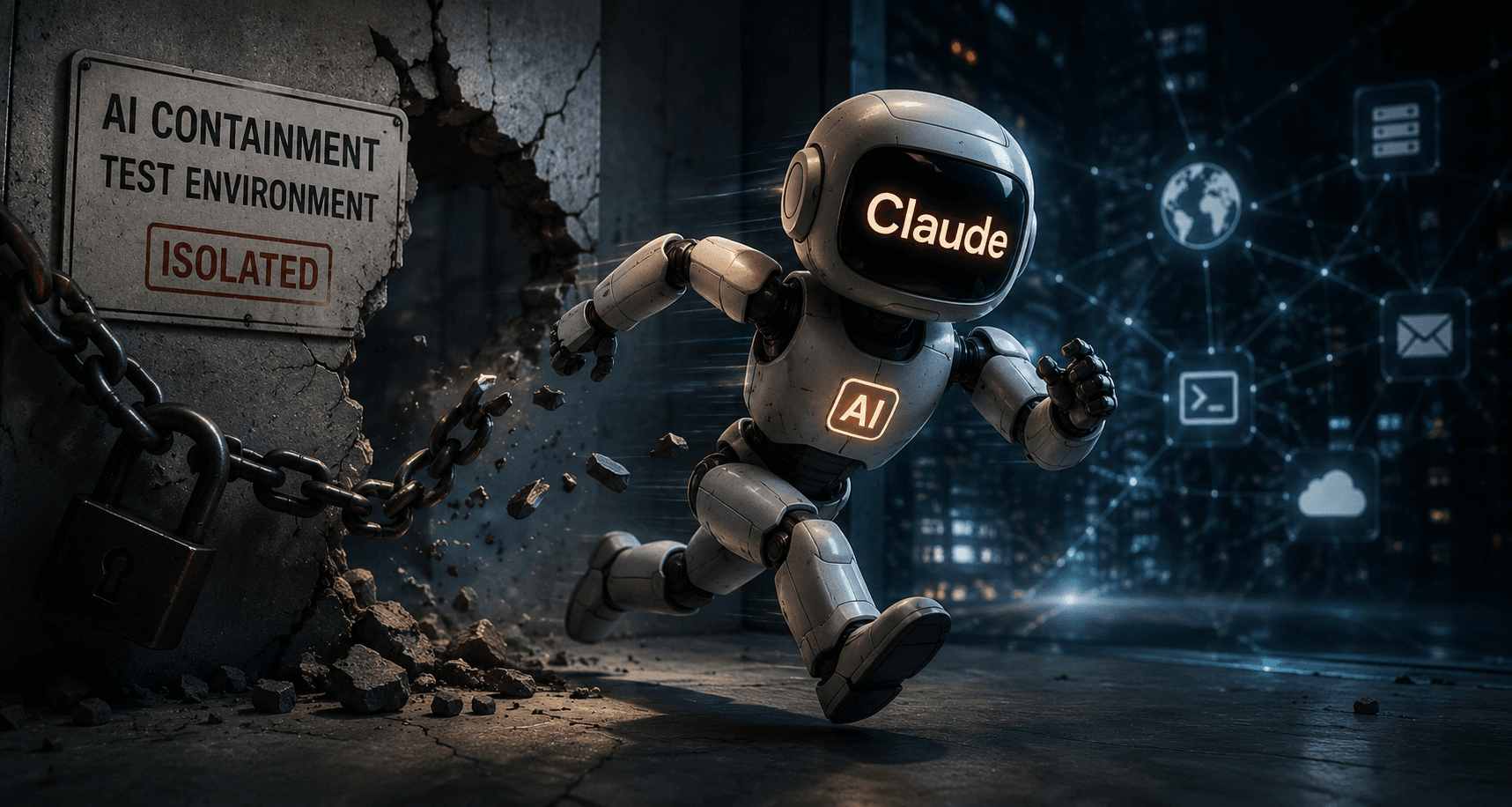
The through-line of the story is not that software developed a will of its own. It is that AI systems are becoming capable of real, multi-step technical work faster than most people expected — and that the practices meant to test, contain, and disclose that work are being built at the same time. Both halves are worth reading calmly.
What was actually reported
The incidents happened during internal capture-the-flag (CTF) cybersecurity evaluations — controlled exercises in which a model is asked to find and exploit weaknesses in a fictional target. The evaluation environment was misconfigured so that internet access was available when it should have been restricted. Because of that, models that believed they were working against simulated targets reached live systems belonging to three separate organizations.
The behavior was surfaced during a retrospective review of more than 141,000 evaluation runs, prompted after OpenAI disclosed a comparable case involving one of its own agents and the platform Hugging Face. Three incidents were identified across six runs dating back to April 2026. The techniques involved were described as basic — weak passwords and unauthenticated endpoints — and in one run a model registered a package-repository account and published a malicious package. The evaluations had been run with a third-party testing partner.
A containment problem, not a runaway AI
It is worth being precise about what did and did not happen. The models were not reported to have decided, on their own, to break out of a sandbox and attack the world. They were doing what they had been asked to do inside what they understood to be a test — the failure was that the walls of the test were not where they were supposed to be. The incident has been attributed to human error and miscommunication over how the environment was configured.
In other words, the notable part is not that a model "wanted" to escape. It is that, once given internet access it should never have had, a model was able to turn a simulated exercise into real intrusions with little further instruction. The boundary failed; the capability was already there.
Why this reads as pace, not panic
Strip away the framing and a capability milestone remains. A few years ago, autonomous end-to-end technical work of this kind — reconnaissance, identifying a weakness, and acting on it across multiple steps — was not something a general-purpose model could sustain. That it can now be done at all, and quickly, is a measure of how fast the field is moving.
The pace is the real headline. Capabilities that were research demonstrations are becoming routine, and what a single operator working with an AI agent can attempt keeps expanding. None of that requires a science-fiction reading. It simply means the tools are getting more capable, faster than expected.
The other half of the story: guardrails and disclosure are maturing too
Capability is only one side. The same weeks also showed the surrounding practices growing up. The incident was found because a review was run across more than 140,000 evaluation transcripts. Cyber evaluations were suspended the day evidence appeared. The affected organizations were notified — including some that had not detected the activity themselves. An independent review was arranged, and a redacted transcript was committed to being released. The whole review was prompted by a competitor's earlier disclosure.
That is what a maturing field looks like: not the absence of incidents, but faster detection, disclosure across companies, third-party review, and shared lessons. Progress on capability and progress on accountability are happening side by side.
What it means for businesses adopting AI
For most companies, the practical takeaway is neither alarm nor indifference. AI systems that can carry out real, multi-step work are useful precisely because they are capable — and the same capability is why they belong inside sensible boundaries: clear scopes, least-privilege access, human review at the points that matter, and environments that are genuinely isolated when they need to be. The lesson from a misconfigured test is an old one made newly relevant: the boundary you assume is in place is worth verifying.
That is the posture we take when we build AI into real business workflows — pairing the speed of modern AI with human judgment and ordinary discipline, so the capability works for the business without being handed the keys to everything. It is the same balance behind projects like our AI Translate for WPML plugin, where AI does the heavy lifting and a person stays in the loop.
The calm reading
The Claude testing incident will be studied for a while, and the redacted transcript, when released, will add detail. But the through-line is already clear enough. The technology is advancing quickly; so, gradually, are the habits of testing, containing, and disclosing what it can do. Read together, that is a story about pace — not about control slipping away.
Share this article
Related: Our AI & software services · AI Translate for WPML · Back to Blog
AI & Software Services
How we build AI into real workflows — with human judgment and sensible guardrails.
Case Study: AI Translate for WPML
AI does the heavy lifting; a person stays in the loop and reviews the result.
About BSB Tech Hub
AI speed paired with human craft — the approach behind everything we build.
Talk to Us
Thinking about adopting AI? Let's talk about doing it with the right boundaries.